

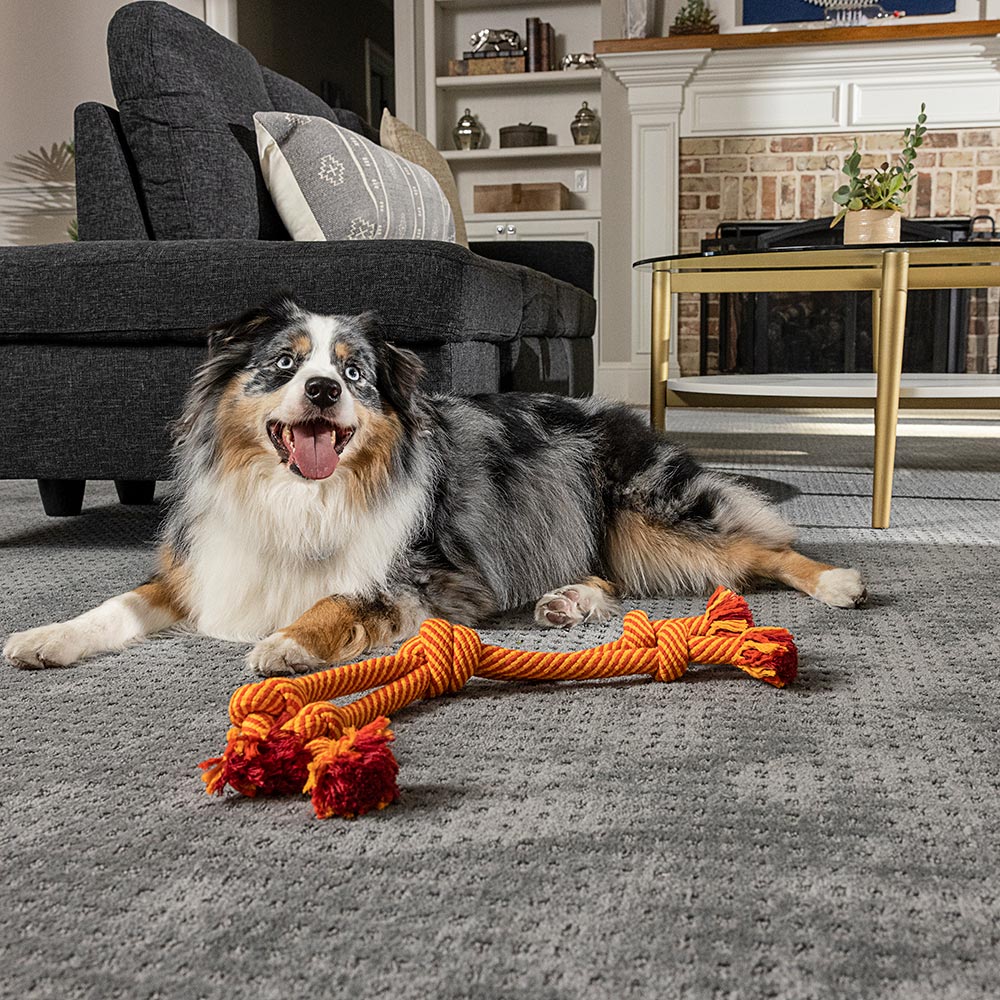
Two out of three homes in this country have a pet tracking across the floor. The American Pet Products Association, the group behind the long-running National Pet Owners Survey, puts it at 66 percent of U.S. households, about 86.9 million homes, and every one of them fights the same seasonal shuffle: wet paws in spring, dusty paws in late summer, and muddy prints whenever central Missouri decides to be central Missouri. Waterproof vinyl has become the default floor for those homes for good reason, but "waterproof" is a marketing word with no single test behind it. What actually decides whether a floor survives your dog is the wear layer on top, the core underneath, and how carefully it goes down.
The labels all say the same thing, so the specs are where the real differences hide. Here is what separates a floor that shrugs off a muddy Lab from one that looks tired in two years.
What Does "Waterproof" Actually Mean on a Vinyl Floor?
"Waterproof" on a vinyl label means the plank itself will not swell or break down when it gets wet, and little more than that. There is no single industry test a floor has to pass to earn the word, so it describes the material rather than the finished floor. What makes the material hold up is a waterproof wear layer over a core that does not absorb water, and for rigid-core vinyl that core is held to a real standard: ASTM F3261, the specification for resilient flooring with a rigid polymeric core, sets pass-or-fail limits for dimensional stability, so a certified plank stays flat and keeps its size when it meets water and temperature swings.
The honest catch is that a waterproof plank is not the same as a waterproof floor. Water and pet accidents find the seams between planks, the gap at the walls, and the subfloor below, none of which the plank's rating covers. A spill wiped up quickly never gets that far. A dog accident that sits overnight, or a water bowl that overflows against a wall every day, can work moisture down to the subfloor through the seams. This is why the install matters as much as the product, and why the right answer in the wettest rooms is sometimes sheet vinyl, which comes in wide pieces with far fewer seams for water to find.
The Wear Layer Is What Survives Pet Claws
The wear layer is the clear top coat that takes the abuse, and on a pet floor it is the single spec that matters most. The World Floor Covering Association, the retail trade body for the flooring industry, calls the wear layer and its thickness the main indicator of how well a vinyl floor stands up to daily use. It is measured in mils, where a mil is one-thousandth of an inch, and a thicker one puts more clear armor between your dog's nails and the printed design below.
For a home with pets, thickness is where to spend. Wear layers commonly run around 12 mil for ordinary residential use and step up to 20 mil or more for busy, pet-heavy households and light commercial spaces. A 6 or 8 mil layer, common on the cheapest planks, is the one to avoid if a dog with untrimmed nails uses the room daily. Many better lines also add a treated top finish, often with aluminum oxide or a urethane coat, that raises scratch resistance further. The design underneath is only a photograph, so once claws wear through the clear layer the damage shows and cannot be buffed out, which is the whole case for buying the thicker wear layer up front.
Rigid Core or Flexible Vinyl for a Pet Household?
Rigid-core vinyl is the more forgiving choice in most pet homes, because the same ASTM F3261 standard that governs it also tests for residual indentation and static load, the properties that decide whether a heavy piece of furniture or a big dog flopping down leaves a mark. Rigid cores come in two main types. Stone-plastic composite, or SPC, is the denser and harder of the two, and under the standard its core has to reach at least 1.95 grams per cubic centimeter, with limestone making up 65 to 75 percent of its weight. That density is what gives SPC its dent resistance and its firm, quiet footing. Wood-plastic composite, or WPC, is a little softer and warmer underfoot, trading some dent resistance for comfort.
Flexible vinyl still has its place. Thin glue-down luxury vinyl and sheet vinyl both handle water well and cost less, and sheet vinyl's near-jointless surface is genuinely useful in a small, wet mudroom. What flexible products give up is the dent and gap resistance the rigid core brings, and they telegraph an uneven subfloor more readily. For a busy family room or a kitchen where a large dog lives, rigid core is usually worth the difference. The table below lays out how the choices stack up for a pet home.
Feature | SPC rigid core | WPC rigid core | Sheet vinyl |
|---|---|---|---|
Dent resistance | Highest, dense stone core | Good, softer core | Lower, no rigid core |
Feel underfoot | Firm and quiet | Warmer and softer | Softest, thinnest |
Seams and water paths | Click seams at each plank | Click seams at each plank | Very few seams |
Best pet spot | Kitchens, family rooms, big dogs | Living areas wanting comfort | Small mudrooms and baths |
Start at the Door: Stopping Mud Before It Reaches the Floor
The fastest way to protect any pet floor is to stop grit at the entrance, because sand and salt act like sandpaper on a wear layer. A tough mat outside each door paired with an absorbent, washable runner just inside catches most of what paws carry in before it reaches the main floor. A grippy pad under that runner keeps it from sliding when a dog hits it at a run, which matters on a slick vinyl surface.
Central Missouri makes this a year-round job rather than a winter one. Spring mud, summer dust, and the road grit that shows up with the first freeze all arrive on the same four paws, so the entry setup earns its keep in every season. Sweeping or vacuuming those entry zones a couple of times a week does more to preserve a floor's finish than any product you can buy for it.
Cleaning Pet Messes Without Wrecking the Floor
Waterproof vinyl is easy to clean, and the mistakes people make are almost always about using too much water or the wrong product. For everyday dirt and dried mud, sweep or vacuum first, then damp-mop with a well-wrung mop and a pH-neutral cleaner made for hard floors. Skip the steam mop entirely: the heat and forced moisture can drive water into the seams and, over time, soften the adhesive on glue-down products. Harsh cleaners and oil soaps dull the finish that gives the floor its shine and its slip resistance.
Pet accidents need a little more care because of where the liquid goes. Blot a fresh accident quickly so it cannot sit in the seams, then clean with an enzymatic pet cleaner, which breaks down the odor compounds a regular cleaner leaves behind. The surface will wipe clean either way, but odor that lingers usually means liquid reached the seams or the subfloor, which is the argument for cleaning up accidents fast and for choosing fewer seams in the rooms where accidents happen. Once the floor is in, our guide to keeping luxury vinyl clean through humid Missouri summers covers the routine in more detail.
Healthier Indoor Air in a Home Full of Pets and Kids
The people and animals closest to a floor are the ones breathing whatever it gives off, which is worth a thought when pets and toddlers spend their days at floor level. Flooring and its adhesives can release volatile organic compounds, or VOCs, into the air, and the simplest way to shop around that is to look for a FloorScore label. FloorScore, developed by SCS Global Services with the Resilient Floor Covering Institute, tests a finished floor against California's Section 01350 method for 35 individual VOCs, including formaldehyde, and the seal means the product met those low-emission limits. It costs nothing to check the box for it, and in a house where the dog and the kids share the rug, it is an easy call.
Where Vinyl Belongs in a Pet Home
Vinyl works almost everywhere a pet goes, and matching the type to the room is how you get the most out of it. In kitchens and family rooms, where big dogs and heavy traffic meet, a 20-mil SPC plank gives you the dent and scratch resistance those rooms demand. In a small mudroom or a pet bath that sees standing water, sheet vinyl's low-seam surface is the safer bet. Bedrooms and quieter living spaces can drop to a warmer WPC or a comfortable luxury vinyl plank. You can compare constructions across the luxury vinyl we carry, and the waterproof flooring guide lays out which options suit the wettest rooms.
Common Questions About Pet-Friendly Waterproof Vinyl
Is vinyl flooring really waterproof?
The vinyl plank itself is waterproof, but the finished floor is only as waterproof as its seams and install. The material will not swell or break down when it gets wet, which is what the label promises. Water can still reach the subfloor through the joints between planks or the gaps at the walls, so wipe up spills and pet accidents before they sit, and choose sheet vinyl where standing water is common.
What wear layer should I choose for dogs?
For dogs, a wear layer of 20 mil or more is the safe choice. The wear layer is the clear top coat that takes claw scratches, and the World Floor Covering Association ties its thickness directly to how long a floor lasts. A 12-mil layer handles ordinary homes, but a house with big or active dogs is where the thicker 20-mil layer pays for itself.
Is SPC or WPC better for pets?
SPC is usually the better pick for a busy pet home because its dense stone core resists dents from claws, furniture, and a heavy dog. WPC is softer and warmer underfoot, which suits a quieter bedroom or living room. Both are rigid-core products built to the same ASTM F3261 standard, so both stay flat and stable when they get wet.
Does pet urine damage waterproof vinyl?
Pet urine will not damage the surface of waterproof vinyl, but urine left to sit can seep into the seams and reach the subfloor, where it causes odor. Blot accidents promptly, clean with an enzymatic pet cleaner that breaks down odor compounds, and the floor itself stays fine. Fewer seams, as in sheet vinyl, give urine fewer places to go.
Can I use a steam mop on vinyl floors?
No, a steam mop is one of the few things that can genuinely harm a vinyl floor. The heat and forced moisture can drive water into the seams and soften the adhesive under glue-down products. Clean with a well-wrung damp mop and a pH-neutral hard-floor cleaner instead, and save the steam for surfaces that are built for it.
Sheet vinyl or plank for a mudroom?
Sheet vinyl is often the smarter choice for a small mudroom because its wide format leaves very few seams for water to find. Plank-style luxury vinyl looks more like real wood and can be repaired one board at a time, which suits larger, drier rooms. In a tight, wet space that takes the worst of muddy paws, the floor with the fewest seams wins.
Choosing the Right Pet Floor for Your Home
The pet floor that lasts is the one matched to the room: a thick wear layer where claws land, a dense rigid core where dents happen, and fewer seams where water pools. Get those three right and waterproof vinyl handles muddy paws, spills, and years of traffic without complaint. When you are ready to compare wear layers and cores in person, bring your household's realities with you, and request a free estimate so we can measure the rooms and match the floor to your pets, your traffic, and your budget.


