

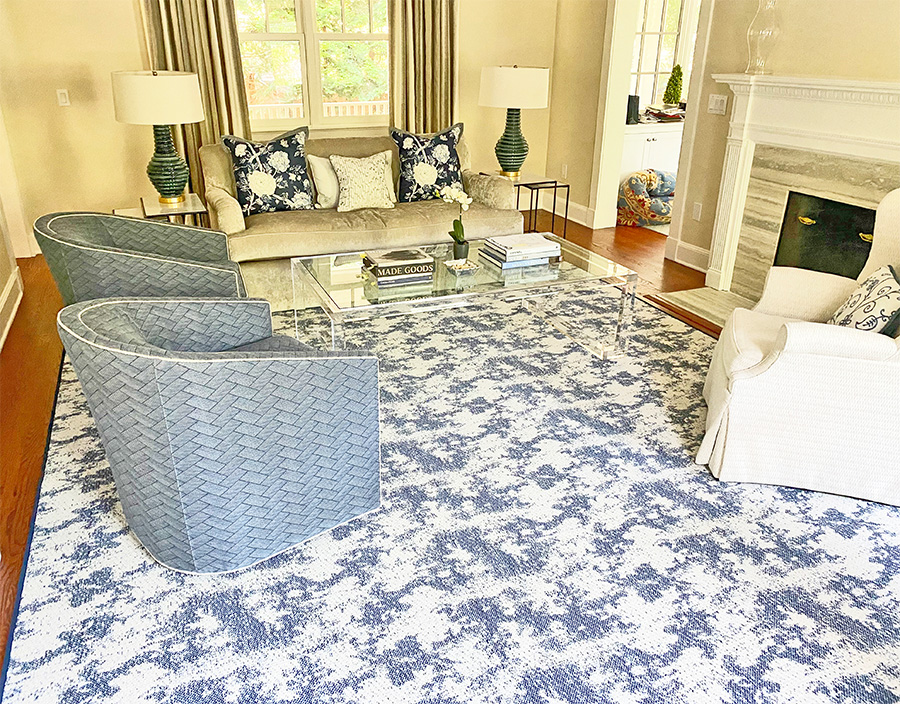
A floor doesn't have to be freezing to feel freezing. The American Society of Heating, Refrigerating and Air-Conditioning Engineers (ASHRAE), the body whose Standard 55 sets the benchmark for indoor comfort in the United States, puts the comfortable range for a floor your bare feet actually touch at 66 to 84 degrees Fahrenheit. In a central Missouri winter, tile and luxury vinyl over a slab or an unheated crawlspace can sit below that for months, which is why the kitchen feels like an ice rink at six in the morning even when the thermostat says the rest of the house is warm. An area rug and a good pad are the fastest and cheapest way to fix it, and doing it well is mostly about the pad, the size, and where the rug goes.
Why Do Hard Floors Feel So Cold in Winter?
Hard floors feel cold because dense materials pull heat out of your foot faster than soft ones do. Tile, stone, laminate, and vinyl are good conductors, so the moment your skin touches them they start carrying your body heat away, and your brain reads that fast heat loss as cold even when the floor is the same temperature as the air. A rug is the opposite. Its pile is mostly trapped air, and trapped air barely conducts heat at all, so the surface stays close to skin temperature and never feels like a shock.
Two things stack up in a Missouri winter to make it worse. The subfloor underneath a slab or a crawlspace runs cold for months, pulling the finished floor down with it, and a long heating season dries the indoor air, which makes everything feel a touch cooler. What your feet register through all of this is the temperature of the surface they are standing on, and that is the number a rug changes. Laid over a cold floor, a rug and pad create a warm layer between you and the chill, so the surface you touch climbs back toward that comfortable ASHRAE band.
How Much Warmth Does an Area Rug Actually Add?
An area rug and a pad add real, measurable insulation, and the surprise for most people is that the pad does more of the work than the rug. Insulation is rated as an R-value, the same scale used for the insulation in your walls, where a higher number means more resistance to heat moving through. An industry study of carpet run by the Georgia Institute of Technology's School of Textile Engineering, the source the Carpet and Rug Institute points to for these figures, measured a typical carpet at an R-value around 1.3 and a dense polyurethane cushion under it at about 1.6, which combine to roughly 2.9.
The split between the rug and the pad is the useful part. A thin rug lying straight on a bare floor adds only its own modest R-value, while a good pad underneath it more than doubles the effect. If a rug's insulation isn't printed anywhere, the same study offers a quick estimate: multiply the total thickness of the pile in inches by 2.6. There is an upper limit worth knowing, too. The Carpet and Rug Institute notes that flooring makers cap how much insulation should sit over a floor at a combined R-value of about 4.0, which matters most over heated floors, where too much padding traps the warmth you're paying to produce.
The Rug Pad Does the Heavy Lifting, and Keeps You Safe
A rug pad is the single best upgrade for a warmer, safer rug on a hard floor. It carries most of the insulation, as the R-values show, and it solves the other problem a rug creates on a slick surface: sliding. That problem is not small. Researchers at the U.S. Centers for Disease Control and Prevention, working from national emergency-room data, estimated that about 37,991 adults age 65 and older are treated every year for falls tied to rugs and carpets, and that nearly three-quarters of those falls happen at home. The riskiest moments they found were a rug that slid, a wet rug, and the raised edge where a rug meets a bare floor.
The fix is straightforward. Use a gripping pad sized a little smaller than the rug so it disappears underneath, keep the edges flat with no curling corners, and wipe up spills before someone hits a wet rug on a hard floor. A felt-and-rubber pad is the pick for most rooms: the felt layer adds warmth and cushioning, and the rubber layer grabs the floor. On luxury vinyl in particular, choose a pad made for hard surfaces, because some cheap solid-vinyl pads can discolor a finish over time.
Which Rooms to Warm First in a Missouri Home
Start with the spots where cold floors actually reach you, which in most central Missouri homes means four zones. The entry is first, because it is where winter walks in and where a rug does double duty as insulation and a grit filter. The kitchen work zone in front of the sink and stove is next, since that's where you stand still on hard tile or vinyl for long stretches. Then the main seating area of the living room, where drafts travel across a big bare floor, and finally the strip of floor beside the bed, which is the first thing your feet hit on a cold morning.
Working through those four in order tends to cover the floors you notice most for the least money. If your home spreads across a walkout or a lower level in the way many homes around Columbia and Jefferson City do, treat the coldest downstairs rooms as their own zone, because a floor over a below-grade slab stays colder longer than one on the main level. Here is a quick map of what tends to work in each zone.
Zone | Rug and pad | Pile height | How to size it |
|---|---|---|---|
Entry and mudroom | Washable low-pile rug on a felt-and-rubber pad | Low, under 1/4 inch | Full width of the doorway; pad about 1 inch smaller all around |
Kitchen work zone | Dense low-pile runner | Low, under 1/2 inch | Leave 3 to 4 inches of bare floor on each side |
Living seating area | Plush wool or nylon on a felt-and-rubber pad | Medium to high | Front legs of the sofa and chairs on the rug |
Beside the bed | Plush wool or soft synthetic | High | 18 to 24 inches of rug showing past the bed |
Sizing an Area Rug So It Actually Warms the Room
A rug that is too small leaves cold gaps exactly where your feet land, so size it to the furniture rather than to the middle of the room. In a living room, the reliable rule is to get at least the front legs of the sofa and chairs onto the rug, which pulls the seating together and puts warm floor under everyone. Under a dining table, the rug needs to run about two feet past the chairs on every side so a chair stays on it when you push back. In a hallway or a galley kitchen, a runner should leave a few inches of bare floor showing on each side rather than crowding wall to wall.
Standard rug sizes rarely match a real room, and that is where a bound remnant earns its place. Instead of settling for a rug that is close, you can have a piece of carpet cut to your exact dimensions and finished with a sewn edge, which is the kind of custom-size work our area rug binding handles. It's the simplest way to warm an odd-shaped entry or a narrow galley without hunting for a size that does not exist.
Materials and Pile: What Feels Warmest Underfoot
Warmth underfoot comes down to fiber and pile height, and the two pull in slightly different directions. Wool is the warmest common rug fiber, a natural insulator that holds its loft and resists crushing, which is why it feels so good on a cold morning and why it costs more. Synthetic fibers like nylon and polyester give up a little of that plush warmth in exchange for easier cleaning and better stain resistance, which is often the smarter trade in a busy family room or a house with pets.
Pile height is the other lever. Because insulation tracks with thickness, a deeper pile traps more air and feels warmer, so a plush rug belongs beside the bed and in the living room. Near the sink and stove, drop to a dense, low-pile rug instead, since it still adds a warm layer but is far easier to keep clean where spills happen. If you want to compare fibers and pile in person before you commit, the area rug guide walks through the options, and you can browse the current area rugs we carry to see what is in stock.
Protecting Your Hard Floors While You Warm Them
Area rugs protect a hard floor as much as they warm it, if you set them up right. Placed at every entrance, they catch the sand, road salt, and grit that would otherwise get ground into the finish of your luxury vinyl or tile with every trip through the door, which is the same grit that dulls a floor's shine over a few winters. A rug in the kitchen work zone catches drips before they sit on a seam.
Two habits keep the rug from doing any harm of its own. Choose a pad rated for your floor type, since the wrong material can leave marks on some vinyl finishes, and shake or vacuum both the rug and the floor beneath it every few weeks so trapped grit is not sanding the surface under the pad. That's the whole maintenance routine, and it's what keeps a warm floor looking new instead of scratched.
Common Questions About Warming Hard Floors With Rugs
Do area rugs actually make a room warmer?
Area rugs make a room feel warmer by insulating the floor and your feet, even though they change the air temperature only a little. The measured R-value of a rug and pad, around 2.9 for a typical carpet over a dense cushion in the Georgia Tech study, is real insulation between you and a cold subfloor. What you feel most is the surface temperature underfoot, and a rug raises that right away.
What kind of rug pad is warmest?
A felt or felt-and-rubber pad is the warmest choice for a hard floor. The felt layer adds thickness, and thickness is what carries the insulation, while a rubber backing grips the floor so the rug cannot slide. A thin foam pad grips well but adds little warmth, so choose felt when a cold floor is the problem you are solving.
Are area rugs safe to put on luxury vinyl and tile?
Area rugs are safe on luxury vinyl and tile when they are secured with a gripping pad and kept flat. The CDC's review of rug-related falls found that sliding rugs, wet rugs, and curled edges caused most of the trouble, all of which a good pad and prompt spill cleanup prevent. Pick a pad labeled safe for hard surfaces so it does not mark the finish.
Is wool or synthetic warmer for an area rug?
Wool is the warmer fiber, because its natural crimp traps more air and holds its loft under foot traffic. Synthetic rugs in nylon or polyester feel slightly less plush but clean up more easily and resist stains, which often makes them the better call in high-traffic rooms. In both cases, a thicker pile and a good pad matter more for warmth than the fiber alone.
Can I put a thick rug over a radiant heated floor?
A thick rug over a radiant heated floor can trap the heat you are paying to produce, so keep the rug and pad on the thinner side there. The Carpet and Rug Institute notes that flooring makers cap combined carpet-and-cushion insulation around an R-value of 4.0, and over radiant heat you want to stay well below that so the warmth still rises through. A low-pile rug with a thin pad is the safe combination.
Warming Your Floors Before the Next Cold Snap
The warmest, safest setup on a hard floor is a well-sized rug on a felt-and-rubber pad, placed in the rooms where cold actually reaches you and kept flat and clean. That combination raises the surface your feet touch, protects the floor from winter grit, and pays for itself in comfort every morning of a long heating season. If you want help matching a rug to the floors you already have, or a remnant cut and bound to an exact size, request a free estimate and we will talk through the options and the sizing with you at our Kingdom City showroom.


