

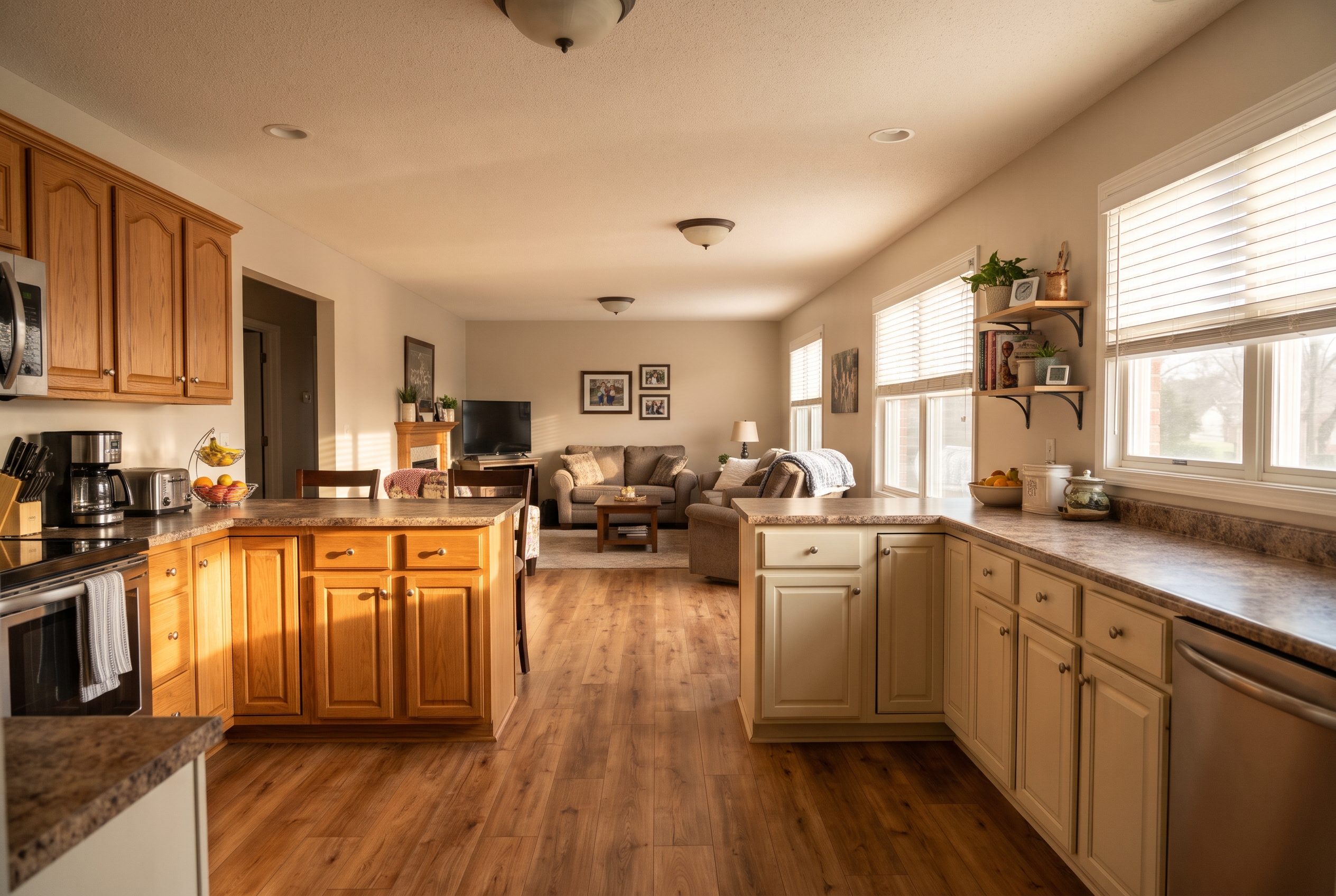
Yes, laminate handles Missouri weather well in a house that is heated and air-conditioned all year, in rooms where water doesn't sit on the floor. Its maker sets a humidity and temperature range for the life of the floor, and the furnace and air conditioner keep a lived-in house inside it. Choose vinyl plank instead where the house sits closed up for weeks, where the floor is a basement slab, or where water stands for hours. Damp air and standing water can't swell a vinyl core.
| Room | Laminate? | Vinyl plank? | Why |
|---|---|---|---|
| Bedroom, living room or upstairs hall | Yes | Yes | Dry air the furnace and AC control |
| Kitchen | If waterproof-rated | Yes | Sink, dishwasher and fridge-line leaks |
| Bathroom, laundry room or mudroom | If waterproof-rated and sealed at the walls | Yes | Splashes, steam and wet boots |
| Basement or other slab floor | If its maker approves the slab | Yes | Moisture rising through concrete |
| Lake house or home left closed up | Only with the heat and AC running | Yes | Laminate needs its range all year |
| Room with strong afternoon sun | Yes | Yes, with blinds or glued down | Heat moves vinyl more than humidity |
What Missouri's Humid Summers and Dry Winters Do Inside Your House
A floor lives in the air inside your house, not in the weather outside. In summer, humid air reaches it whenever the air conditioner is off and the windows are open. In winter, the furnace warms cold outdoor air that holds very little water, and warm air with little water in it is dry air. A heated house runs driest in the coldest weeks of January.
The EPA's guide to mold and moisture in the home sets the target for indoor air below 60 percent relative humidity, ideally between 30 and 50 percent. That band is comfortable, it keeps mold from getting a start, and it sits inside the range the laminate makers we carry write for their floors. A house that stays in it all year is a house where laminate does fine.
An inexpensive humidity gauge, called a hygrometer, tells you where your house actually sits. Set one in the room where the new floor will go, and read it through a muggy week in July and a cold week in January.
In summer, the air conditioner does most of the work, and a dehumidifier in a finished basement keeps the lower level in range. In winter, a humidifier on the furnace or a portable unit in the room brings the air back up. If the inside of the windows fogs on a cold morning, the air is wetter than the house can hold, so turn the humidifier down a notch.
The houses that fall outside that band are the ones nobody is living in for a while: a lake place shut down from October to April, a house for sale with the thermostat turned down, a rental between tenants. Those houses need a floor chosen for the months nobody is home.
How Laminate Reacts When the Air Turns Humid or Dry
Laminate's core is wood fiber pressed into a board with resin. Like wood, it takes on moisture from humid air and swells a little, then gives it back to dry air and shrinks. A floating laminate floor is built for that movement. It isn't fastened to the subfloor, and a gap at every wall, hidden under the baseboard or quarter round, gives it room.
The makers draw the line in their installation instructions, and they write it for the life of the floor. Mannington's instructions for its Restoration Collection laminate ask for a house between 65 and 90 F and between 30 and 65 percent humidity, held there for as long as the floor is down. Mohawk's installation instructions for its laminate set 60 to 85 F and 35 to 65 percent, and its care rules ask that the room's humidity always stay in that band.
In thermostat terms, a laminate floor wants a house kept between about 65 and 85 F, with the humidity between about 35 and 60 percent. If you heat and cool your house year-round, that is probably where it already sits.
Push the air past the top of the range for weeks, and the boards swell against each other. The joints rise into a slight ridge, called peaking, or the floor lifts where a wall or a cabinet leaves it no room. Let the air drop under the bottom of the range, and the boards shrink until hairline gaps open at their ends, most often in January. Mannington leaves at least 5/16 inch at every wall for that seasonal movement.
Both makers' laminate is in our laminate catalog, where the Water Protection filter separates the lines rated waterproof from the ones rated water resistant.
Is Waterproof Laminate Really Waterproof?
Yes against water on top of the floor, for as long as its maker says, and no against water that gets underneath. Mannington sells its Restoration Collection with SpillShield Plus Waterproof Technology and names kitchens, bathrooms, laundry rooms and mudrooms as rooms it suits. The surface and the tight, coated joints keep a spill from reaching the core.
Mohawk's laminate carries a residential water warranty too, on planks 5/16 inch and thicker. In bathrooms, kitchens, laundry rooms and mudrooms, its instructions ask for the gap at every wall to be filled with flexible silicone to keep that warranty. A sealed edge is what stops a spill from running under the floor.
What a waterproof rating doesn't change is the core. It is still wood fiber, so it still needs the house's humidity inside the maker's range, and it can't sit in water that runs under it from a supply line, a flood or a wet slab. Where spills get wiped up and leaks get caught the same day, a waterproof-rated laminate works in a kitchen or bath. Where water stands for hours or comes up from underneath, vinyl plank takes it in stride, because its core doesn't absorb water at all.
How Vinyl Plank Reacts to Heat, Cold and Sun Instead
Vinyl plank barely notices humidity, because a vinyl core doesn't absorb water from the air. Temperature moves it instead: vinyl grows a little as it warms and shrinks as it cools. A floating vinyl floor needs a gap at the walls too, and for vinyl that gap makes room for heat.
Mannington's instructions for ADURA Max, a rigid vinyl plank we carry, ask for the room and the cartons to sit between 55 and 90 F for two days before and during installation. They skip that wait when the heat or air is already running and the cartons are within 15 degrees of the room. They call for a 1/4 inch gap at the walls with nothing pinning the floor, and they say the floor should never see more than 140 F.
Sun is the usual way a floor gets that hot. Afternoon light through a big west or south window can heat one patch of a floating floor well past the rest of the room. The same instructions ask you to close the blinds where strong sun hits the floor, and they suggest a glued ADURA floor where the sun is extreme. A sunroom floor faces the most of it. In a sunroom heated and cooled with the rest of the house, a glued plank, held down across its whole back, is the steadier choice. A three-season room that goes cold in winter is different. Mannington's glue-down ADURA Flex asks for the room to stay above 55 F after installation. Its instructions for ADURA Rigid, a stone-core plank, recommend that line for three-season rooms and seasonal homes over concrete, with a wider 5/8 inch gap at the walls.
Rigid core vinyl, the thicker planks built around a stiff WPC or SPC core, moves less with temperature than a thin flexible plank. The Construction filter in our luxury vinyl catalog sorts the cores, and ADURA Rigid, ADURA Max and COREtec's Pro and Originals lines are among the rigid core floors there.
Which Floor Belongs in Each Room of a Missouri House
Water on the floor, or air the house can't keep in range, points to vinyl plank. A dry room in a house that is heated and cooled all year can take either floor, and then the look and feel under your feet make the choice.
Which Floor Goes in a Kitchen and the Rooms That Open Onto It?
Vinyl plank is the safer kitchen floor, and a waterproof-rated laminate works in a kitchen that stays dry. The risk in a kitchen is the slow leak nobody sees. A dishwasher supply line, the ice maker line behind the fridge or a drip under the sink can run under the floor for a week before anyone notices.
Vinyl plank is unharmed by that water. A waterproof laminate is protected from the spill you wipe up, not from water spreading underneath it, so a laminate kitchen depends on catching leaks early. A water shutoff you can reach and an inexpensive leak sensor behind the dishwasher and the fridge catch a leak while it is still a towel and not a floor.
In an open plan, the kitchen usually sets the floor for the whole main level. One floor running through without a break looks best and avoids a transition strip at the kitchen's edge, so you choose for the kitchen even in the living room. A very long open run may still need a break strip at a doorway to give the floor room to move.
Can Laminate Go in a Bathroom, Laundry Room or Mudroom?
Yes, if it is a waterproof-rated laminate installed to its maker's wet-room rules, though vinyl plank is the easier fit where water stands. Mannington and Mohawk both ask for the gap at the walls, around the toilet flange and at exterior doors to be sealed with silicone in these rooms. That seal keeps water from getting under the edge of the floor.
Where the floor regularly sits wet, vinyl plank doesn't care how long the water stays. Think of a kids' bathroom where half the bath ends up on the floor, or a mudroom where boots drip all winter. A room with a floor drain or a sump pump is no place for laminate, because the drain is there for water that crosses the floor, and that rules out the utility room in many basements.
A dog that comes in wet brings the same water on a smaller scale. A towel and a mat by the door do more for either floor than any rating.
Should a Living Room or Bedroom Get Laminate or Vinyl Plank?
Either one works in a house that is heated and cooled, and in these rooms you choose on looks, feel and sound. Bedrooms, living rooms and upstairs halls see little water, and the furnace and air conditioner keep their air steady.
Laminate's deeply textured surface often reads more like real wood up close, and its hard top holds up well to the fine scratches of daily life. Vinyl plank is a little softer and quieter underfoot. If one floor will run from the kitchen through the living room and down the hall, the kitchen's needs usually make the call for all of it.
Judge the two in the light of the room they're going into. A sample plank laid on the floor by the window for a few days tells you more than a display does, especially next to the cabinets, trim and furniture it has to live with.
Can Laminate Go Over Concrete in a Basement or a Slab Home?
Yes, laminate can go over a dry concrete slab with the moisture barrier its maker calls for, and in a basement, vinyl plank is the safer floor. Concrete can pass moisture up from the ground all year, so a laminate floor on it sits over a surface that is never completely dry. Mohawk's laminate instructions set a limit on how much moisture the concrete may give off, and they call for a 6-mil plastic moisture barrier under the underlayment unless the underlayment has one built in.
In a basement, the bigger question is the day water comes in. A basement that has taken on water once will do it again in a hard spring rain, and a laminate floor that sits in water has to come out. Rigid core vinyl plank and sheet vinyl are our picks for a basement floor for that reason.
A slab-on-grade ranch, where the floor sits at ground level, can take laminate on a dry slab, and vinyl plank is the choice where the slab has a history of moisture. Under vinyl, damp concrete can leave water trapped beneath a floor that won't let it pass. Either way, the slab gets a moisture test, and the film, the pad and the test limits follow the instructions for the plank you choose.
What Floor Works in a Lake House or a Home Left Closed Up for Weeks?
Vinyl plank, unless the heat and air stay on. The laminate ranges hold for the life of the floor, so a weekend place at the lake with the thermostat at 50 all winter and the air conditioning off all summer sits outside them for months at a time.
If you want laminate there, keep the thermostat at 65 F or higher all winter, the bottom of the stricter of the two laminate ranges. Run the air conditioner or a dehumidifier so the summer humidity stays under the top of the range while you are away. That is a real heating and cooling bill for an empty house.
Vinyl plank asks less of an empty house, and the rigid stone-core lines ask the least. Mannington rates ADURA Rigid for a lived-in range of 55 to 100 F. It rules the line out only where the floor could fall below -20 F or climb past 150 F, and it recommends ADURA Rigid for seasonal homes. For a closed-up summer house, draw the blinds on the lake side before you leave and set the air conditioner to a temperature you'd tolerate walking into, instead of turning it off. In winter, leaving the heat on low rather than off protects the pipes and keeps any floor closer to the conditions it was laid in.
How Laminate and Vinyl Plank Compare Beyond the Weather
Away from water, the difference you'll live with is laminate's harder surface against vinyl's softer one. Laminate's top is a hard, clear layer over the printed wood image, and it resists fine scratches from grit, pet nails and chair legs well. Vinyl is softer, so a dropped pan is less likely to chip it, but a heavy piece of furniture on narrow legs can dent it where laminate would hold.
Laminate's deep embossing often reads more like real wood up close, though the better vinyl lines have closed much of that gap. Underfoot, laminate feels firmer and vinyl a little softer and quieter. With either floor, most of the noise depends on what is underneath, and a quieter floor starts with the underlayment.
| Factor | Laminate | Vinyl plank |
|---|---|---|
| Humidity swings | Swells and shrinks with humidity | Barely affected |
| Water standing on top | Swells if water reaches the core | Unharmed |
| Heat and strong sun | Little movement from heat alone | Grows with heat |
| Fine scratches | Resists them well | Shows them sooner |
| Narrow furniture legs | Holds up well | Can dent |
| Feel underfoot | Firmer | Softer and quieter |
What Laminate and Vinyl Plank Cost Installed
Nationally, laminate runs about $4 to $14 a square foot installed and luxury vinyl plank about $4 to $16, in HomeGuide's cost guide comparing laminate and vinyl flooring. The material is $1 to $6 a square foot for laminate and $2 to $10 for luxury vinyl. Labor and supplies add $3 to $8 a square foot for laminate and $2 to $6 for vinyl.
| Floor | Material per sq ft | Installed per sq ft | 12 by 15 room, installed |
|---|---|---|---|
| Laminate | $1 to $6 | $4 to $14 | $720 to $2,520 |
| Luxury vinyl plank | $2 to $10 | $4 to $16 | $720 to $2,880 |
The low end of each range is a basic, thinner plank laid over a clean, flat floor. The top end is a thick waterproof-rated laminate, or a rigid core vinyl with a thick wear layer and a pad attached. The water rating, the core and the attached pad are what the extra dollars buy.
Some work is priced on top of the floor itself. Homewyse's cost estimate for removing flooring runs about $2.50 to $4.50 a square foot nationally, so taking out old carpet or vinyl in that 12 by 15 room adds roughly $450 to $810. Leveling a subfloor that dips, stairs, and the transition strips at each doorway add more. On a job with an old floor to pull up or a slab to level, those lines can matter as much as the choice between laminate and vinyl.
You also buy a little more than the room measures. Planks get cut at every wall, and a spare carton belongs in a closet for the day a board needs replacing.
Why a Floating Floor Gaps in January or Peaks in July, and What to Do
A floating floor that opens up in January or rises along its joints in July is almost always following the air in the house. The fix is to bring the air back into the floor's range. A floor that won't settle once the air is right has something pinning it or water under it.
Why Do Gaps Open Between Laminate Boards in Winter?
The furnace has dried the air under the bottom of the laminate's range, so the boards have given up moisture and shrunk. The gaps show first at the short ends of the boards and in the rooms nearest the furnace. They close again as the air comes back up.
Raise the humidity to at least 35 percent, the bottom of the stricter of the two laminate ranges. A humidifier on the furnace or a portable one in the room does it, and so does running the bathroom and kitchen fans for fewer hours in January. Read a hygrometer for a week before and after.
Gaps still open when spring humidity returns usually mean the joints have pulled apart at the locks. Those rows have to be taken up and reset.
Why Does a Laminate Floor Peak or Lift in Summer?
A laminate floor peaks in summer when the air has been too humid for too long, or when the floor has nowhere to go. Humid air swells every board a little, and across a room that adds up. If the gap at the wall is pinned, the floor has nowhere to go but up.
The usual pins are a cabinet set on top of the floor, a heavy kitchen island, shoe molding nailed down through the planks and a door casing cut too tight. Run the air conditioner or a dehumidifier to bring the room back under 60 percent. Then free the edges: pull trim nailed into the floor and nail it to the wall, trim back a board jammed against a cabinet, and give the floor around an island its gap back.
Joints that stayed peaked for weeks can stay damaged after the air comes down, and those boards get replaced.
What Does a Swollen Seam by the Dishwasher Mean?
Water has reached the laminate core, and a core that has absorbed water doesn't shrink back down. The swollen edges stay raised after the floor dries, and the boards around the leak have to be replaced.
Stop the leak first, then dry the area under the floor within a day or two so mold can't get a start. A spare carton or two from the original order, kept in a closet, is what makes the repair invisible. A board from the same run matches the floor, and a board bought years later often doesn't.
Why Did a Vinyl Plank Floor Rise After a Hot Spell or a Closed-Up Summer?
Heat expanded it past its gap. A floating vinyl floor in a house left without air conditioning through a hot stretch, or the patch of floor in front of a west window, grows until it presses against the walls. Then the middle lifts or the joints buckle.
Cool the room, close the blinds and give the floor a day or two to relax. Check the walls and doorways for anything pinning the floor, such as a transition strip screwed through it or trim nailed into it. A floor that keeps lifting in the same sunny spot is better off glued down.
We Carry Both Floors and Install Them From Our Kingdom City Showroom
At Carpet Values, we carry laminate and luxury vinyl plank side by side in our 40,000-square-foot showroom at I-70 and Route 54 in Kingdom City. You can stand on both floors there before you choose one.
For kitchens and baths on the laminate side, we carry the Restoration Collection and Mohawk's waterproof-rated lines. On the vinyl side, ADURA Rigid, ADURA Max and COREtec's lines are among our rigid core floors, and we keep luxury vinyl in stock.
Our crews handle residential installation, so the floor you pick here is the floor we put down. When you're ready to price your rooms, a free estimate with a project specialist is the place to start, and you can spread the cost with financing.
Questions We Hear About Laminate and Vinyl Plank in Missouri
Will Mold Grow Under Laminate Flooring?
No, not under a dry floor. Mold needs moisture to grow, so it shows up under laminate or vinyl plank only where water got under the floor and stayed. A leak that ran for days, a slab passing moisture or a damp crawlspace under the subfloor will do it, while water dried within a day or two doesn't give it the chance. A musty smell from a floor means water is still getting in somewhere, and the source gets fixed before the floor does.
Does Laminate Need to Acclimate Before It's Installed?
Not always, and the two laminate makers we carry handle it differently. Mannington says its laminate doesn't need to acclimate under normal conditions, only when the cartons were stored or shipped through extreme heat, cold or humidity. Mohawk asks for its thinnest 7 mm planks to sit in the sealed cartons in the room for 48 hours. Its other laminate needs the same wait only when the storage conditions differ from the room by more than 25 F or 20 points of humidity.
Does Laminate Flooring Keep a House Cooler?
No. A floor settles to the temperature of the room it's in, so laminate and vinyl plank feel about the same as the air once they've been down a while. Either one laid over a concrete slab feels cooler underfoot than one over a wood subfloor, because the slab under it stays cool. An area rug is the quick fix for that in winter.
Which Lasts Longer, Laminate or Vinyl Plank?
Neither lasts longer across the board; in a dry, conditioned room, both last many years, and different things shorten each one. Water that reaches the core is what ends a laminate floor early. Sun, heat and dents from narrow furniture legs are what age a vinyl one. In your house, the room you put it in matters more than the material.
Bring Your Room Measurements and Compare Both Floors in Person
If your house stays heated and cooled and the room stays dry, choose on looks and feel. If the room gets wet or the house sits empty for weeks, choose vinyl plank. Either way, standing on both is the quickest way to decide. Bring your room sizes to Kingdom City, look at the two side by side, and when you know which way you're leaning, request a free estimate for your rooms.


