

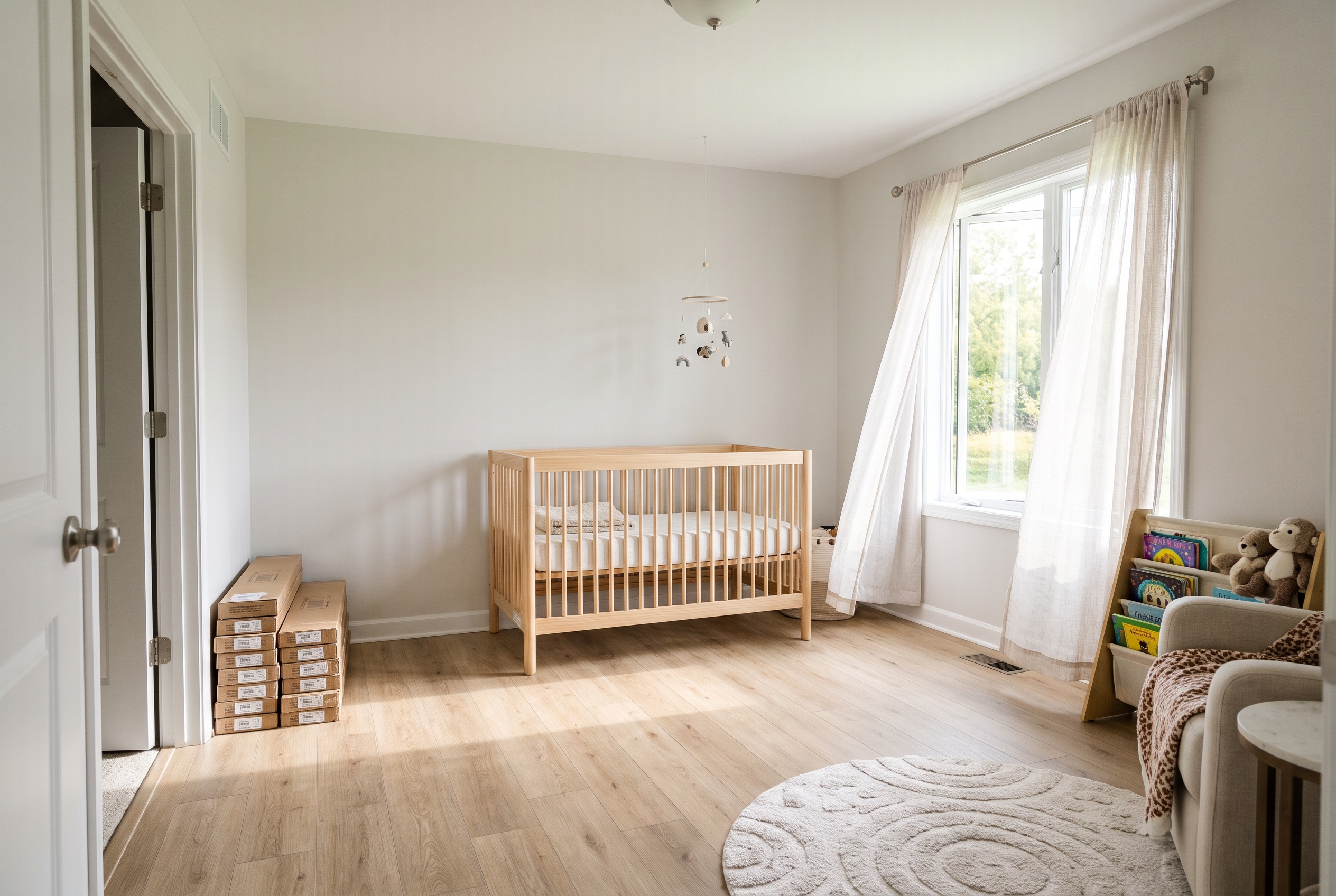
A vinyl plank floor with a FloorScore or GREENGUARD Gold label has passed an independent test of what it gives off into a room's air. Once it has aired out, it's a safe floor to live on. Those labels test the air, so for phthalates and heavy metals the check is a content certification called ASSURE or the maker's written statement. In an older house, the floor that needs the most care is usually the old one coming up, not the new one going down.
| Label | What it checks | What it doesn't check | Where to look it up |
|---|---|---|---|
| FloorScore | VOCs the floor gives off | Phthalates and other content | SCS Green Products Guide |
| GREENGUARD Gold | VOCs, under stricter limits | Phthalates and other content | UL's product certificate |
| ASSURE Certified | Ortho-phthalates, four heavy metals and VOCs | Floors other than WPC and SPC | SCS Green Products Guide |
| Prop 65 warning | Possible exposure to a listed chemical | Whether the floor is unsafe | California's P65 Warnings site |
What Is a Vinyl Plank Floor Made Of?
A vinyl plank is a printed image of wood or stone under a clear wear layer, bonded to a core. The vinyl is a resin made workable with a plasticizer and kept from breaking down with stabilizers. A stone-core plank, called SPC, adds powdered limestone to make the core rigid. A foamed core, called WPC, adds tiny air pockets that make the plank lighter and a little softer underfoot.
Without a rigid core, a flexible glue-down plank stays bendable. Many rigid planks also carry a thin foam or cork pad on the back.
Each of those materials raises its own safety question. The plastic, the pad and any adhesive give off VOCs while they are new, and emissions labels such as FloorScore measure that. The plasticizer and any metals in the plastic are a question about content, answered by a content certification or the maker's statement. In an older house, the floor that comes up first raises the asbestos question, and only a lab test settles it.
How Long Does a New Vinyl Floor Give Off VOCs?
A new vinyl floor gives off the most in its first days, and the labels judge it at day 14, once the amount is changing slowly. The EPA's guidance for new homes says building materials give off VOCs at their highest levels when they are new. VOCs, or volatile organic compounds, are chemicals that leave a material as a gas, and they're part of what you smell in a freshly finished room.
California's emissions test method, which FloorScore and GREENGUARD Gold both use, airs a sample out in clean air for 10 days and then seals it in a test chamber for four more. The reading that decides a pass comes at day 14. The method treats that as an early but realistic time to move into a new or renovated space, and by then most products change only slowly from week to week.
That timing answers the worry that vinyl "off-gasses for years." Emissions from most materials taper off slowly after the first weeks. The useful question is the level you will live with, and that is the level a label tests at day 14.
Fresh air is what speeds the first days along. That same guidance calls for ventilating with outside air at the highest rate you can, during installation, shortly after it and before anyone moves in. The agency's renovation checklist for schools notes that the typical advice is as much outdoor air as possible for 72 hours after a new floor goes in. That's a sensible minimum for a room at home too.
Adhesive and underlayment add to what's in the air in those first days. FloorScore covers adhesives and underlayments as well as floors, so a glued floor and a separate pad each deserve a label of their own. A floating floor with its pad attached leaves out the adhesive altogether.
What Do FloorScore and GREENGUARD Gold Test, and How Do You Look Up a Floor?
Both labels test what a finished floor gives off into the air, against limits set by the California method. FloorScore is run by SCS Global Services and covers hard surface flooring, adhesives and underlayments. A floor earns it through a review of its formula, an audit of the factory and an emissions test for 35 specific VOCs.
GREENGUARD is UL's emissions program, and its Gold tier is the stricter one. Gold sets lower limits than the standard tier, covers more than 360 VOCs and caps the floor's total emissions as well.
You can check a FloorScore floor yourself in a few minutes:
- Open the SCS Green Products Guide and search for the maker's brand name.
- Find the collection named on your sample or quote, since a certificate lists collections and a brand may have several.
- Confirm the collection is listed as FloorScore certified, and look up any adhesive or underlayment the install calls for the same way.
- For a GREENGUARD floor, find the product's certificate on UL's website.
If the collection you want isn't listed, the label in a brochure may belong to another collection from the same maker. Treat that floor as unlabeled until the maker's own pages show a certificate that names it.
Is FloorScore or GREENGUARD Gold Better for a Home?
It depends on who will use the room. Either label tells you the floor passed an independent emissions test under the California method, and that's enough for a kitchen, a hall or a basement. GREENGUARD Gold is the stricter of the two, with lower limits, more chemicals and a cap on the total. It was written for places such as nurseries, schools and health care buildings, so for a nursery, or a home where someone has asthma or a chemical sensitivity, look for Gold.
When you choose from the luxury vinyl we carry, compare floors by their label as well as by their look and core. COREtec says all of its luxury vinyl is GREENGUARD Gold certified, and Mannington lists its ADURA floors as FloorScore certified. Either way, look up the collection you're choosing.
Does Luxury Vinyl Contain Phthalates Today?
It depends on the floor, and a content certification or the maker's written statement is how you tell. Phthalates are plasticizers, and the older ortho-phthalates are the ones vinyl flooring was known for. SCS says FloorScore leaves phthalates out because vinyl flooring is not considered an emission source for them. The exposure that matters is swallowing them, as with toys and plastic bottles, which makes phthalates a question about what's in the plank.
The content check for rigid core floors is ASSURE, a certification created by the Resilient Floor Covering Institute, the resilient flooring makers' trade association, and tested and certified by SCS. It applies to WPC and SPC floors wherever they are made. An ASSURE floor cannot exceed 1,000 parts per million of ortho-phthalates, counted individually or in total, and must meet the California emissions method too.
ASSURE also tests for lead, cadmium, mercury and hexavalent chromium and holds the four together to 100 parts per million. The maker must also attest that none were added on purpose. Certified products are listed in the same SCS Green Products Guide as FloorScore floors, so one search covers both. For a floor without ASSURE, the maker's written statement on ortho-phthalates, on its product or sustainability pages, is the next best evidence.
Is Vinyl Plank Safe for Babies, People With Asthma and Pets?
Yes, a labeled vinyl plank floor is safe for babies, for people with asthma and for pets. The same habits protect all three: a low-emitting floor and adhesive, fresh air during and after the installation, and a floor that is kept clean.
Is Vinyl Plank Safe for a Baby Who Crawls on It?
Yes, vinyl plank is safe for a baby once the floor is labeled and the room has aired out. For a nursery, choose a GREENGUARD Gold floor, since Gold is the tier written for nurseries and schools. Then look for ASSURE or the maker's phthalate statement for what's in the plank. A crawling baby's hands and mouth meet the floor's surface, so the content check matters more in a nursery than anywhere else in the house.
Plan the nursery floor a couple of weeks before the baby will use the room. That gives the floor the same 14 days the California test allows before it reads a floor, with the windows open and fans running for the first few. After that, damp-mop the floor and vacuum it with a HEPA filter, because whatever settles on the floor ends up on small hands.
Is Vinyl Plank Safe With Asthma or Chemical Sensitivity?
Yes, vinyl plank is safe with asthma when the floor carries GREENGUARD Gold and goes down without adhesive. Gold holds the floor itself to the tighter limits. A floating floor with its pad attached leaves out the adhesive, one more material that gives off VOCs while it is new.
If you can, stay somewhere else on installation day and for the first couple of days after it. Leave the windows open and the bath and kitchen fans running while the floor airs out, and run the HVAC fan to keep the air moving. Smooth floors that can be damp-mopped are usually easier on allergies and asthma than surfaces that hold dust, and vinyl plank is one of them.
Is Vinyl Flooring Safe for Dogs and Cats?
Yes. A finished vinyl plank floor is safe for pets to walk, sleep and eat on, and the risks come from installation day and from cleaning. Keep pets out of the room while planks are cut and laid, then pick up every offcut, since a puppy will chew a loose scrap of vinyl like any other plastic.
Clean with the cleaner the floor's maker recommends and rinse, so no residue stays where paws and noses go. Claws are a matter of wear, and the wear layer is what keeps a pet-friendly vinyl floor looking new.
What Does a Prop 65 Warning on a Flooring Box Mean?
It means the business believes the product may expose you to a chemical on California's list of substances linked to cancer or reproductive harm. California's Office of Environmental Health Hazard Assessment runs Proposition 65. Its P65 Warnings site says a warning does not mean a product violates safety or health standards, and no warning is required when an exposure is low enough to pose no significant risk.
The warning names the chemical, and the state's guidance is that the manufacturer or importer can tell you which exposure prompted it. Makers often print one carton for every state, so the warning can turn up on a floor sold in Missouri. Read which chemical it names, then check the collection's emissions label and the maker's content statement, which tell you more about the floor than the warning can.
Why Does the Old Floor Coming Up Deserve More Care Than the New One?
An old floor coming up in an older house can contain asbestos, in the floor itself or in the materials under it, and asbestos becomes a hazard once it's sanded, scraped or broken up. Old sheet vinyl backing, the felt lining under it and black cutback adhesive are among the materials that may contain asbestos fibers. A tear-out in an older house starts with that question.
The EPA's advice for a floor that might contain asbestos comes down to a few rules:
- If you're in doubt, treat the material as asbestos and leave it alone.
- Don't sand the floor or try to level it, and that includes its backing.
- When the floor needs replacing, cover it with new flooring if you can.
- Have a trained, accredited asbestos professional take any samples, since sampling it yourself is not recommended.
Covering is often the simplest route. When the plank's instructions allow it, a floating floor can go right over an old resilient floor that's flat and well bonded, leaving the old one sealed underneath. If the old floor has to come out, the lab result comes first, and the plan for removing it follows from that result.
How Do You Keep Exposure Low the Week a Vinyl Floor Goes In?
Keep exposure low by planning the installation week around fresh air and dust, since a new floor gives off the most in its first days:
- Choose a labeled floor, and a labeled adhesive or underlayment if the install calls for one.
- Choose a floating floor with an attached pad if you would rather have no adhesive at all.
- Have planks cut outside or in the garage, or scored and snapped, to keep dust out of the living space.
- Keep children and pets out of the room on installation day.
- Ventilate for at least three days afterward, with the windows open and the bath and kitchen fans on, and run the HVAC fan to keep the air moving.
- Vacuum the new floor with a HEPA filter and damp-mop it before the furniture goes back.
If the old floor is coming up, settle the asbestos question before the first plank is cut.
Does a Low-Emitting, Phthalate-Free Vinyl Plank Cost More?
Usually not, and the national range for vinyl plank is the place to start. HomeGuide's luxury vinyl cost guide puts it at about $4 to $16 a square foot installed, with $2 to $10 of that for the material and $2 to $6 for labor. Where a maker certifies a whole line, as COREtec and Mannington do, every floor in the line carries the label.
A 10 by 12 nursery comes to about $480 to $1,920 installed at those rates, before any subfloor repair. The core, the wear layer, an attached pad and the subfloor work are what move a room within that range.
What Should You Check on Any Vinyl Floor Before You Buy It?
Check the documents for the exact collection you're pricing. A floor that clears this list is one you can put in a nursery:
- An emissions label on the collection: FloorScore or GREENGUARD Gold, and Gold for a nursery.
- The collection in the certifier's listing, such as the SCS Green Products Guide.
- The content side: ASSURE certification, or the maker's written statement on ortho-phthalates.
- The install materials: a labeled adhesive and underlayment, or a floating floor with its pad attached.
- The carton: if it carries a Prop 65 warning, the chemical it names.
- The old floor: its age, and a plan to cover it or have it tested before anything is torn out.
- The airing-out plan: at least three days of fresh air, and who stays out of the room.
A floor that misses one of the first three items is not necessarily unsafe, but it hasn't shown you the evidence the others have. Keep the list with your samples, and check each floor you're still considering against it before you compare prices.
Low-Emitting Vinyl Plank Is on Our Showroom Floor in Kingdom City
At Carpet Values, we carry labeled vinyl plank from COREtec and from Mannington's ADURA lines in our flooring showroom in Kingdom City, at I-70 and Route 54. You can compare COREtec's Pro and Originals next to ADURA Rigid and ADURA Max there, by label as well as by look.
When you've chosen a labeled floor, our crews can put it down as part of our residential installation service. To get a price for your rooms, book a free estimate and meet with one of our project specialists.
Questions We Hear About Vinyl Plank and Indoor Air
Is Laminate Safer Than Vinyl Plank?
No, laminate isn't safer than vinyl plank as a category, and the least toxic flooring is the labeled floor you can keep clean, whatever it's made of. Laminate's core is wood fiber bound with resin, so formaldehyde is the chemical people ask about there.
FloorScore covers hard surface flooring of every kind, so the same emissions label answers the question for laminate. Compare the labels on the two floors you're considering, then choose on how each handles water and wear.
Is Sheet Vinyl as Safe as Vinyl Plank?
Yes, when it carries the same label. A labeled sheet vinyl has passed the same emissions test as a labeled plank.
Sheet vinyl is usually glued, at the edges or across the whole floor, so the adhesive's own label is part of the check. ASSURE covers only rigid core floors, so for sheet vinyl the content check is the maker's written statement on ortho-phthalates.
Does Vinyl Flooring Give Off More When It Gets Hot?
Yes, a vinyl floor gives off more when it is warm, as any building material does, so a new floor in a sunny room deserves the longest airing out.
Draw the blinds in a room with strong afternoon sun during the first weeks. Keep radiant heat within the plank's instructions too, which for ADURA Rigid cap the floor's surface at 85 F.
What If a New Floor Still Smells After a Week or Two?
Keep ventilating, and look at the other new materials in the room before you blame the planks. A glued floor's adhesive or a new underlayment can keep smelling after the floor has settled, and so can fresh paint or new furniture.
If the smell is musty rather than chemical, it points to moisture under the floor, and the floor needs a look underneath before the moisture does any damage.
Compare Labeled Vinyl Floors in Our Showroom
A safe vinyl floor is one you can check: an emissions label on the collection, a content certification or written statement for what's in it, and a plan for the floor coming up. Bring your room sizes and the age of the floor you're replacing to Kingdom City, compare the labeled lines side by side, and request a free estimate for your floors when you're ready.


