

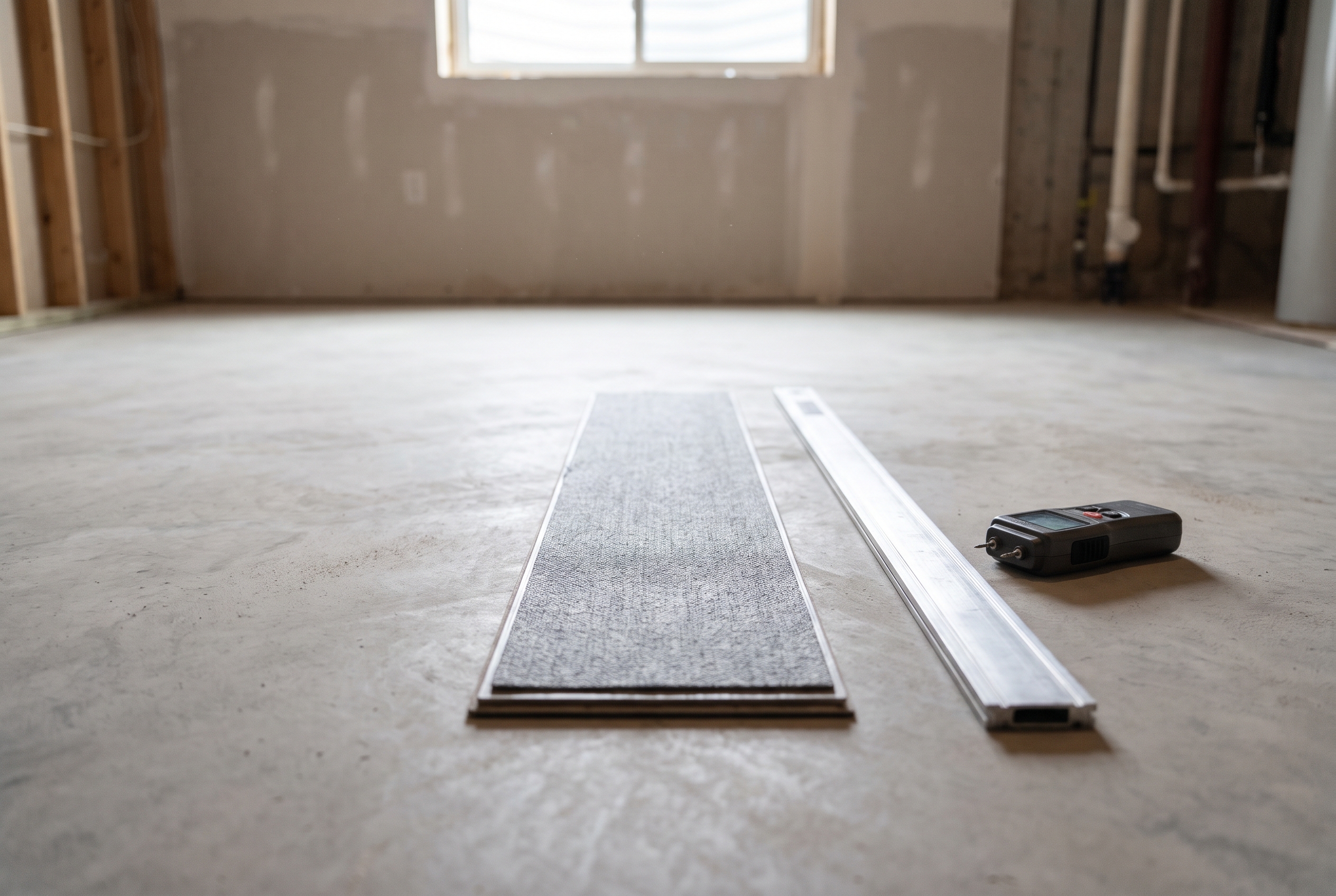
If your vinyl plank has a pad on its back, nothing else goes under it, not even a sheet of plastic on the slab unless that plank's own instructions call for one. A plank with a bare back gets the thin underlayment named in its instructions, and a glued plank gets nothing but adhesive. Under every one of them, the subfloor has to be flat, dry and solid before the first plank goes down, and getting it there is most of the work.
| Subfloor | Moisture step | Cushion | Prep first |
|---|---|---|---|
| Concrete slab | Test to the plank's stated limit | The plank's pad or approved underlay | Patch, grind and check flatness |
| Plywood over a crawlspace | Plastic on the crawlspace soil | The plank's pad or approved underlay | Moisture meter, screws, sanded seams |
| Old ceramic tile | Same as the floor under it | The plank's pad or approved underlay | Fill deep grout joints |
| Old sheet vinyl, one firm layer | Same as the floor under it | The plank's pad or approved underlay | Leave it intact and never sand it |
| Carpet | Not a base for vinyl | None | Take it up |
Does Your Vinyl Plank Already Have Underlayment Attached?
Yes, if the back of the plank has a layer of foam or cork bonded to it, and then no other cushion goes under it. Mannington builds the pad onto ADURA Max and ADURA Rigid and says no additional pad. Mohawk's guidelines for its rigid vinyl go further: a plank with the pad attached can't be installed over separate underlayment at all.
Both rules protect the joints: a rigid plank's click-lock edge is made to sit on a firm base, and a second cushion lets it flex with every step until the lock wears or the seam opens. A padded plank on a second pad feels softer for a while and then starts to separate.
Check before you buy anything for underneath. Turn a sample over, because an attached pad is a thin gray, black or cork-colored layer on the back. The spec sheet lists it too, and the Built-in Underlayment filter in our luxury vinyl catalog sorts out the floors that have one, ADURA Max, ADURA Rigid and ADURA APEX among them.
That pad is part of the floor's design. ASTM International's standard for rigid core vinyl, F3261, describes it as an underlay that quiets the floor and rides over minor flaws in the subfloor. A rigid plank needs no other cushion.
Which Underlayment Goes Under a Vinyl Plank Without a Pad?
Only the underlayment named in that plank's installation instructions, and nothing thicker or softer. Mohawk's rigid vinyl guidelines, for example, recommend the company's own ActiveSound underlayment for a plank without a pad. The product named in the instructions is the one the warranty assumes.
This mostly applies to thinner rigid planks sold with a bare back. Look for the underlayment section of the installation sheet, usually near the subfloor rules, and buy what it names rather than what the roll in the aisle says it suits.
What doesn't belong under any vinyl plank is the thick, soft foam sold for laminate, and carpet pad of any kind. Both let a vinyl plank flex at its joints. Foil-faced laminate foams add a plastic film as well, and on a slab that film can work against the plank's own moisture rules.
A glued plank takes no underlayment at all. It's spread with adhesive and pressed straight onto a smooth floor, so anything under it is part of the subfloor, not a cushion.
Underlayment does help with footstep noise, which matters most upstairs, and a quieter floor depends as much on what's under the plank as on the plank itself. Underlayments carry their own emissions labels, so the one under your floor deserves the same check as the floor on top.
Do You Need a Vapor Barrier Under Vinyl Plank?
Over a concrete slab, yes, but in the form the plank's instructions call for, and for many rigid vinyl planks that isn't a plastic sheet laid on the slab. Over a wood subfloor, the moisture control belongs in the crawlspace under the house.
You'll read that every slab needs 6 mil polyethylene under the floor, whatever the instructions say. The habit comes from laminate, whose instructions do call for it: on concrete, Mohawk wants its laminate laid over underlayment and a 6-mil plastic moisture barrier.
Mannington says the opposite for its floating ADURA vinyl. It doesn't recommend 6 mil poly directly under those floors, and it wants the vapor retarder beneath the slab. It also warns that plastic laid on top of a damp slab can leave poor conditions under the plastic and up the walls.
Vinyl plank is waterproof from the top, but a slab breathes moisture up from the ground. What matters is whether that moisture is low enough for the floor and its pad, so the slab gets a moisture test before anything goes down. If it's over the limit, the fix is more drying time or a moisture-mitigation coating made for concrete, not a sheet of plastic. Follow the instructions for the plank you buy, because the warranty follows them.
How Does Vinyl Plank Go Down Over a Concrete Slab?
It goes down after the slab passes a moisture test and is flat and clean. The calcium chloride test, ASTM F1869, seals a dish of salt under a dome on the concrete and weighs the moisture it absorbs, in pounds per 1,000 square feet per day. The in-slab probe test, ASTM F2170, reads the relative humidity inside small holes drilled into the concrete. Both give a number you can hold up against the plank's limit.
Each line sets its own pass mark. The floating ADURA floors allow up to 8 pounds or 85 percent. ADURA Flex, glued with its own adhesive, allows up to 10 pounds or 95 percent. Mohawk's rigid vinyl allows up to 8 pounds or 90 percent, and its guidelines ask you to keep the readings. A new slab needs at least six weeks to dry before an ADURA floor goes on it.
Taping a square of plastic to the floor overnight and looking for droplets is a quick screen, nothing more. The plastic-sheet method only shows whether moisture is present, so it can't tell you whether a slab passes a stated limit.
On a basement floor or a slab-on-grade ranch, the steps are the same:
- Clear the slab of old adhesive, paint, sealers and anything loose.
- Test it for moisture by the method the plank's instructions name, and keep the readings.
- Fill cracks and saw cuts with a Portland cement patch, and grind down high spots.
- Check the flatness with a long straightedge.
- Lay the planks pad side down, with the gap left at every wall.
Rigid core vinyl plank, with its waterproof core and attached pad, is the usual choice for a basement floor, as long as the slab tests within the limit.
How Does Vinyl Plank Go Down Over Plywood Above a Crawlspace?
It goes down over a dry, solid, flat wood subfloor, with the moisture control on the ground under the house rather than on top of the wood. The crawlspace soil gets covered with 6 mil plastic, the vents stay open, and the plywood should read 12 percent moisture or less. Plan on about 1.5 square feet of vent opening for every 100 square feet of crawlspace, unless local codes say otherwise.
Check the plywood with a pin-type moisture meter from the hardware store. Screw down loose panels and anything that squeaks, and sand high seams flat. A rough or damaged subfloor gets covered with 1/4 inch underlayment panels.
A damp crawlspace shows itself as cupped or musty plywood. Fix that from the crawlspace, with the plastic and the vents, before any floor goes on top.
Can Vinyl Plank Go Over Old Tile, Sheet Vinyl or Hardwood?
Yes over one layer of firmly bonded hard flooring that is flat, and never over carpet. Mannington's padded ADURA lines can float over old ceramic tile with its grout lines still in it. Carpet, cushioned vinyl and floating laminate or hardwood come up first, and grout joints deeper than about 1/8 inch get filled level.
Every layer you keep raises the floor. Check the door clearances, the dishwasher opening and the step to the next room before you decide to leave an old floor in place.
Older resilient floors need one more check. Sheet vinyl, floor tiles and the black adhesive under them in older houses can contain asbestos. The EPA's advice is plain: don't sand or try to level asbestos flooring or its backing, cover it with new flooring if you can, and have a trained, accredited professional take any samples. A floating vinyl plank over an old floor that is intact and flat leaves it undisturbed.
How Flat Does the Subfloor Have to Be, and How Does It Get There?
Flat enough that no gap under a 10-foot straightedge is bigger than 3/16 inch. Under a 1-foot straightedge, no gap should pass 1/32 inch, about the thickness of a credit card. Those are the ADURA instructions' numbers for floating and glued floors alike, and 3/16 inch over 10 feet is the usual rule for rigid vinyl.
To check, lay a long, straight board or a level across the floor in several directions and slide a tape measure or a stack of shims into the gaps. A flashlight held low across the floor at night shows the humps. Mark every low and high spot with a pencil.
- Low spots and cracks: a Portland cement patch or a self-leveling compound, troweled smooth and feathered out.
- High spots in concrete: ground down.
- High seams in plywood: sanded flat.
- A rough or damaged wood floor: 1/4 inch underlayment panels over it.
- A dip that comes from the framing: fixed at the joists, before any floor goes down.
A rigid plank with an attached pad hides small flaws that would print through a thin glued plank, but it doesn't change the flatness number. Flatness is the one step you can't make up for after the floor is down.
What Else Has to Happen Before the First Plank Goes Down?
Before the first plank goes down, the old floor comes out where it has to, the edges get ready and the subfloor gets clean:
- Take up whatever can't stay: carpet, pad, tack strips, staples and cushioned vinyl.
- Pull the baseboard, or plan on quarter round to cover the gap at the walls.
- Undercut the door casings and jambs so the plank slides under them.
- Scrape off lumps of old adhesive, then sweep and vacuum.
- Acclimate the cartons if the instructions ask for it; ADURA Rigid needs no wait in a house kept near 70 F.
- Plan the gap at every wall, 1/4 inch for ADURA Rigid, and where the transitions fall at doorways.
- Check the finished height at appliances and exterior doors.
What Does Subfloor Prep for Vinyl Plank Cost?
On an older house, prep can come close to the cost of the floor. Homewyse's national estimate for tearing out a floor is about $2.50 to $4.50 a square foot. HomeGuide's floor repair cost guide puts an uneven floor at $500 to $3,000 a room on average, with self-leveling compound handling the minor cases. Its luxury vinyl cost guide prices a new subfloor at about $2 to $5 a square foot, or $440 to $1,200 for a smaller repair.
| Prep item | National cost | 12 by 15 room |
|---|---|---|
| Removing the old floor | $2.50 to $4.50 a sq ft | $450 to $810 |
| Leveling an uneven floor | $500 to $3,000 a room | $500 to $3,000 |
| Replacing the subfloor | About $2 to $5 a sq ft | $360 to $900 |
| Repairing part of a subfloor | $440 to $1,200 | $440 to $1,200 |
A padded plank saves the cost of a separate underlayment, and a slab that passes its moisture test needs no mitigation coating. When a bare-back plank needs underlayment, that's one more material line on the quote. An old resilient floor that might contain asbestos costs more to take out than to cover, one more reason to leave a sound one in place.
What Are the Signs of a Problem Under a Vinyl Plank Floor?
A problem under a vinyl plank floor usually shows up as a sound, a feel or a smell, and each one points to its own cause.
Clicking or a hollow sound in one spot means the plank is bridging a dip. The rows come up from the nearest wall, the low spot gets filled, and the planks go back down.
A soft, bouncy feel across the whole floor means a second cushion sits under a padded plank. The extra layer has to come out, and planks whose joints flexed on it may need replacing.
Joints opening or edges rising along one line usually follow a high seam underneath, or an edge pinned by trim, a cabinet or a transition screwed through the floor. Free the edge, and sand or grind the seam flat.
A musty smell, dark marks along the walls or a white powder on the slab under a lifted plank means moisture. A leak gets stopped and the area dried within a day or two. A slab that's over its limit gets more drying time or a mitigation coating before the floor goes back.
Plywood that cups over a crawlspace points to the crawlspace itself: bare soil, blocked vents or standing water. Lines or bumps showing through a glued plank are something on the subfloor printing through, and that plank comes up so the spot can be smoothed.
We Carry Padded Vinyl Plank and Install It From Kingdom City
At Carpet Values, we keep padded vinyl plank on the floor in our Kingdom City showroom at I-70 and Route 54. Mannington's ADURA Max, ADURA Rigid and ADURA APEX are among those padded floors, and ADURA Flex is among our glue-down lines.
You can order samples of those ADURA lines to try on your own subfloor. For a quicker start, pick from the luxury vinyl we keep in stock. We handle the job through our residential installation, and when you're ready to price the floor and the work under it, request a free estimate with one of our project specialists.
Questions We Hear About What Goes Under Vinyl Plank
Do You Need Underlayment Under Vinyl Plank in a Bathroom?
No, not under a plank with its pad attached. A bathroom asks for the same subfloor as any room, plus a sealed edge, and the ADURA instructions call for silicone along the tub and the toilet flange. Check that the floor around the toilet is solid and dry before the plank goes down, since an old wax-ring leak often leaves soft subfloor behind.
Can Laminate Underlayment Go Under Vinyl Plank?
Not under a padded plank, and not under a bare-back plank unless its instructions name that exact product. Foam sold for laminate, including the foil-faced kind with a built-in film, is thicker and softer than a vinyl plank's joints are made to sit on. Its film also adds a moisture layer the plank's instructions may not want. If a roll's label says it works under vinyl, the vinyl's instructions still have the final word.
Does Vinyl Plank Need a Vapor Barrier on a Second Floor?
No. A second floor over a dry, heated wood subfloor has no ground moisture under it, so the film and moisture-test rules for slabs and crawlspaces don't apply. What matters upstairs is flatness, squeak-free panels screwed tight to the joists, and the footsteps that carry to the rooms downstairs.
Start With the Floor Underneath, Then Choose the Plank
Whatever plank you're drawn to, its instructions set what goes under it, and the subfloor you have sets how much work comes first. Bring photos of the floor you're covering and your room sizes to Kingdom City, and when you're ready to price the job, request a free estimate for your floors.


