

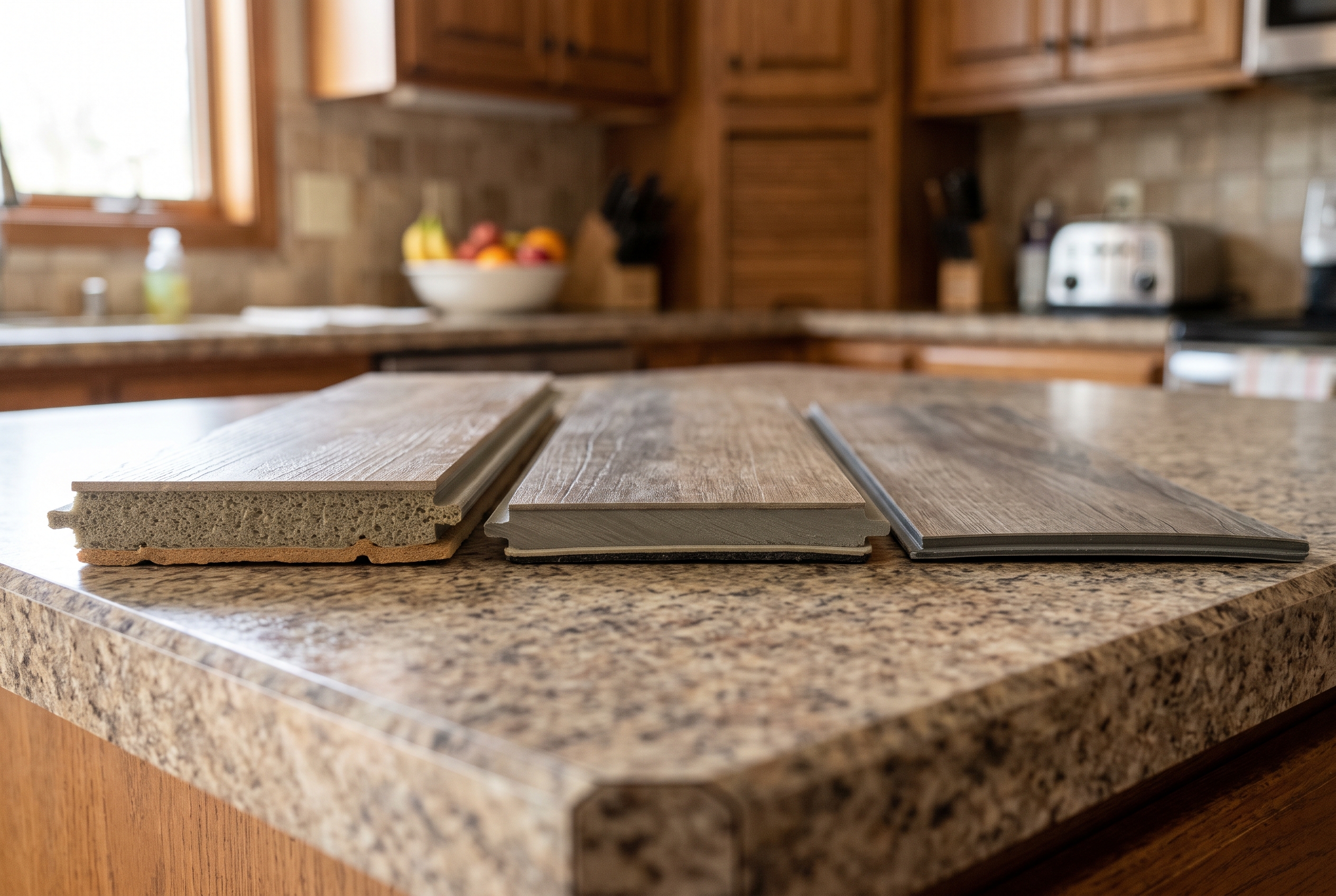
Pick the core by what's underneath and what sits on top. On a concrete slab, under a kitchen island or in a room that swings hot and cold, SPC's stone-and-vinyl core is the steadiest floor. Over a sound plywood subfloor in bedrooms and living rooms, WPC's foamed core is softer and warmer under bare feet. A thin flexible plank glued to a flat, smooth floor holds still in a heated room with strong sun, runs long without break strips, and costs the least to buy.
| Core | Best rooms | Subfloor it needs | Underfoot |
|---|---|---|---|
| SPC (stone core) | Kitchens, basements, seasonal homes | Flat, with small flaws hidden by the pad | Firm and cool |
| WPC (foamed core) | Bedrooms, living rooms, upstairs | Flat and solid, usually plywood | Softer and warmer |
| Flexible, glued down | Sunny heated rooms, long open runs | Flat and smooth, since every bump shows | Thin and firm |
What Are WPC, SPC and Flexible Vinyl Plank Made Of?
All three share the same top: a clear wear layer over a printed image of wood or stone. What differs is the core under it. The core sets how the floor feels, how it moves with heat, how it carries weight, and how flat the subfloor under it has to be.
SPC usually stands for stone plastic composite. It's vinyl mixed with powdered limestone and pressed into a thin, dense, heavy board. WPC started out as wood plastic composite, and today it means a thicker, lighter core of vinyl foamed with tiny air pockets, which gives it a little cushion. Mannington, one of the makers we carry, uses the plainer names: it calls ADURA Rigid a solid polymer core floor and ADURA Max and ADURA APEX expanded polymer core floors.
A flexible plank is vinyl all the way through, thin enough to bend in your hand. Flexible planks are usually glued to the floor, and some click together or lie loose.
Rigid core is the umbrella name for SPC and WPC together. ASTM International's standard for the category, F3261, covers vinyl tile and plank built on a rigid polymer core. It also allows an attached underlay, a thin pad on the back that quiets the floor and rides over minor flaws in the subfloor. LVT and LVP describe the shape, tile or plank, and say nothing about the core.
How Can You Tell Which Core Is in the Box?
The spec sheet says it, usually on a line labeled construction or core, and so do the carton and the maker's product page. In our luxury vinyl catalog, the Construction filter sorts the floors into WPC, SPC and rigid core, and the Wear Layer Thickness filter sorts them by their clear top coat. On any spec sheet, read these lines together:
- Core or construction: WPC, SPC, rigid core or flexible.
- Total thickness, which is mostly core.
- Wear layer in mils, the clear top coat that takes the scratches.
- An attached pad, if there is one, and what it's made of.
- Installation method: click-lock floating or glue-down.
You can check by hand, too. Lift a carton, because SPC is the heaviest of the three for its size, and bend a sample: a flexible plank bows, and a rigid one doesn't.
Where Does SPC's Stone Core Do Its Best Work?
SPC does its best work on concrete, under heavy furniture, and in rooms that swing hot and cold. Its dense core resists dents and moves little with temperature. Mannington markets ADURA Rigid for its indentation resistance and names kitchens, kids' rooms and home gyms as its rooms.
Temperature is where SPC stands apart. ADURA Rigid's installation guidelines put its lived-in range at 55 to 100 F and rule it out only where the floor could drop below -20 F or pass 150 F. They recommend it for three-season rooms and seasonal homes over concrete, with a wider 5/8 inch gap at the walls, which makes it the core for a lake place that's closed up for the winter.
SPC also runs long and goes over a lot. ADURA Rigid can cover up to 50 by 50 feet with a 1/4 inch gap at the walls, and up to 100 by 100 feet with a 3/8 inch gap. An open main level rarely needs a break strip. It can go over an old hard floor such as ceramic tile, grout lines included, as long as the tile is flat and bonded.
A dense core feels firmer and cooler underfoot than a foamed one, and it can sound sharper under hard shoes. The attached pad is what softens both, so compare the pads when you compare SPC lines, and stand on a sample before you choose one for a bedroom. Our SPC floors include ADURA Rigid and REALTA SPC, COREtec's Pro lines and Shaw Floors' Anvil Plus.
Where Does WPC's Softer Core Earn Its Place?
WPC earns its place over a sound wood subfloor in the rooms you walk barefoot: bedrooms, living rooms, a family room over the basement. Its foamed core is thicker and has a little give, so it feels warmer and softer than SPC and takes the edge off footsteps.
Its limits come from the same give. A narrow, heavy point load can press into a foamed core. The ADURA Max and ADURA Rigid instructions both ask for wide-bearing casters or protectors under heavy furniture, and felt pads under chair and table legs. Swap narrow bed-frame feet and piano casters for wide cups, and move appliances in on a hand truck over sheets of hardboard.
WPC is also a floor for a heated and cooled room. ADURA Max's instructions set 55 to 90 F for installation and a 140 F ceiling after it. They ask for blinds where strong sun hits the floor, and they keep it out from under cabinets and kitchen islands. An unheated sunroom or a room that bakes in afternoon light is better served by SPC or a glued plank.
Within WPC, a thicker plank and a better attached pad buy more comfort, and the wear layer buys more years in a busy room. Our WPC floors include ADURA Max and ADURA APEX, COREtec's Originals, Shaw Floors' Pantheon HD Plus and Metroflor's French Quarter.
When Is a Flexible Glue-Down Plank the Better Buy?
A flexible plank glued to the floor is the better buy in a heated room with strong sun, in a long open run, and where the budget is tight. Glue holds it down across its whole back, so heat can't push it around. Mannington says its glue-down ADURA Flex can run long without transition strips and can have cabinets installed right on top of it.
The subfloor under a glued plank has to be smoother than under a rigid one. The ADURA Flex instructions hold it to the same flatness as the floating ADURA lines, within 3/16 inch over 10 feet and 1/32 inch over 12 inches. But a thin plank glued tight shows roughness that a rigid plank with a pad rides over, so a trowel ridge, a nail head or a grain of grit can print through to the surface.
Glue-down is choosier about what it goes over, too. ADURA Flex shouldn't go over an old resilient floor, and ceramic tile has to be skimmed smooth with a cement overlay first. On a slab, the adhesive specified for it tolerates a little more moisture than the floating ADURA lines do.
The room has to stay above 55 F after ADURA Flex is installed, which rules out an unheated three-season room. In exchange, a damaged plank comes out on its own: the instructions have you warm it with a heat gun, lift it out and glue in a spare. Our glue-down floors include ADURA Flex and Metroflor's Deja New.
Some flexible planks click together or lie loose instead of gluing down. They float like a rigid plank without a rigid plank's stiffness, so the subfloor under them has to be as flat and smooth as for a glued floor.
Which Vinyl Core Should You Choose for Each Room?
Heavy loads, big temperature swings and concrete point to SPC. Comfort over a good wood subfloor points to WPC. Strong sun in a heated room, or a run you'd rather not break, points to a glued flexible plank.
Which Core Holds Up Under a Kitchen Island and Heavy Appliances?
SPC or a glued plank holds up best in a kitchen, because a kitchen is where weight sits still for years: the island, the range, the fridge. The under-cabinet guidelines for ADURA Rigid have the cabinets go in first and the floor run around them. A freestanding island under 250 pounds can sit on top of the finished floor, and a heavier one gets the floor installed around it.
ADURA Max, the WPC, isn't meant to go under cabinets or an island at all, and ADURA Flex, glued down, can have cabinets set right on it. A floating floor pinned by a heavy island has nowhere to move as the seasons change, and its joints are what give.
Put the fridge and range on wide glides, use the same hand truck and hardboard to roll them in, and keep a felt pad under every stool.
Which Core Feels Best in Bedrooms, Living Rooms and Upstairs?
WPC feels best, over a sound plywood subfloor. Its thicker, foamed core is the softest and warmest of the three under bare feet, and a bedroom asks little else of a floor. SPC with a good attached pad is the better choice where a heavy bed, a piano or a treadmill sits, or where the room is over a slab.
If you choose SPC for its toughness and miss the softness, an area rug and pad where you stand most, beside the bed or in front of the couch, closes most of the gap.
Upstairs, footsteps carry to the rooms below whatever the core, and a quieter floor comes mostly from the pad and what's under it.
Which Core Goes Over a Basement or Other Concrete Slab?
SPC first, WPC second, and glue-down only on a slab that is dry and smooth. A slab is cool, it can carry moisture up from the ground, and it's rarely perfectly flat. SPC's dense core and attached pad ride over small flaws and don't mind the cool surface. WPC is just as waterproof on top and feels warmer on concrete, which matters in a finished basement family room.
A glued plank on a slab depends on the adhesive's bond, so it needs the concrete dry, clean and smooth, and a basement that has ever seeped is a poor bet for it. Whichever core you pick, the slab gets a moisture test first, and the plank's maker sets the limit and says what goes between the slab and the floor.
Which Core Handles Hot Afternoon Sun Through Big Windows?
A glued plank in a heated room, or SPC, handles strong sun best. Sun through west and south glass heats one patch of floor far past the rest of the room. Glue holds a flexible plank still through that, while a floating floor needs the blinds drawn at the hottest hours, and ADURA Max's instructions suggest a glued ADURA floor where the sun is extreme.
If the room also goes cold in winter, the glued plank drops out, because ADURA Flex needs 55 F or more after installation. A three-season room over concrete is ADURA Rigid's job, with its wider gap at the walls, and that's the floor for a sunroom that isn't heated in January.
Which Core Works in Bathrooms, Laundry Rooms and Mudrooms?
All three cores work in a bathroom or laundry room, because all three are waterproof on top; the seams and edges are what let water in. Water that gets past the edge of a floating floor can run underneath it, while a glued floor has no space under it to fill. SPC or a glued plank is the better choice where water lands often.
Seal the edges at the tub and the toilet flange with silicone, as the ADURA instructions ask, and keep a mat at the door.
Dogs are wet-room traffic too, and the wear layer protects a pet-friendly vinyl floor more than the core does.
Which Core Fits Commercial Spaces and Rentals?
A glued plank fits commercial floors, and SPC fits a rental that turns over often. Shops, offices and clinics see rolling carts and chairs all day, and a glued floor takes rolling loads without shifting. We handle commercial installations for those spaces.
In a rental, SPC resists the dents of moving day. Keep a carton of spares for the property, because a damaged plank in a floating floor can be unclicked and replaced from the nearest wall.
Does the Core Matter More Than the Wear Layer?
No, because the core and the wear layer do different jobs. The core sets how the floor feels underfoot and how steady it stays. The wear layer, the clear top coat measured in mils, or thousandths of an inch, sets how long the surface stands up to grit, claws and chair legs.
So choose the core for the room and the wear layer for the traffic. Two planks with the same core and different wear layers are different floors, and a thick plank isn't automatically a tough one, because most of its thickness is core. For a busy family room or a dog's path to the back door, read the wear layer line on the spec sheet before you look at anything else.
What Do WPC, SPC and Flexible Vinyl Plank Cost?
Nationally, the material runs about $3.50 to $7 a square foot for SPC, $4 to $12 for WPC and $1.50 to $10 for a flexible all-vinyl plank, in Fixr's cost guide for luxury vinyl plank flooring. The same guide puts installation labor at $1.50 to $6 a square foot, which brings SPC to about $5 to $13 installed, WPC to $5.50 to $18 and a flexible plank to $3 to $16.
| Core | Material per sq ft | Installed per sq ft | 400 sq ft, installed |
|---|---|---|---|
| SPC | $3.50 to $7 | $5 to $13 | $2,000 to $5,200 |
| WPC | $4 to $12 | $5.50 to $18 | $2,200 to $7,200 |
| Flexible | $1.50 to $10 | $3 to $16 | $1,200 to $6,400 |
SPC is usually cheaper than WPC at the material: its range tops out at $7 a square foot, while WPC's reaches $12, where the thickest cushioned planks sit. Within any core, the wear layer, the thickness, an attached pad and the brand move the price.
Labor for a glued floor runs higher than for a click floor, because of the adhesive, the trowel work, the roller and the smoother subfloor it needs. Taking up an old floor and leveling a subfloor are priced on top of all three.
What Goes Wrong With Each Core, and How Do You Head It Off?
Each core has one way it most often goes wrong, and each fix costs less before the floor goes down than after. A floating SPC or WPC floor that clicks, sounds hollow or opens at one joint is bridging a dip in the subfloor. The plank flexes every time someone steps there, and the locking edge wears. Flatten the floor first; after the fact, the rows come up, the low spot gets filled and the planks go back.
A WPC floor with round dents under the dining chairs or the fridge has met a narrow point load. Wide protectors under the furniture and glides under the appliances prevent it.
A glued plank that shows a line or a bump is printing something underneath: a trowel ridge, a seam in the plywood, a crumb of old adhesive. A glued plank that lifts at its edge has lost its bond, usually to moisture from the slab. Smoothing the floor and testing the slab before installation prevent both, and afterward the plank gets warmed, lifted and replaced.
Any floating floor, SPC or WPC, lifts or buckles when something pins it: an island set on top, a cabinet, trim nailed down through it. Free the edge and the floor relaxes.
All Three Vinyl Cores Are in Our Kingdom City Showroom
At Carpet Values, we carry SPC, WPC and glue-down vinyl plank in our showroom at I-70 and Route 54 in Kingdom City. You can stand on each core there before you choose one, from Mannington's ADURA and COREtec's Pro and Originals to Shaw Floors and Metroflor lines.
You can also order samples of lines such as ADURA Rigid and ADURA Max to try at home. If you'd rather not wait on an order, start with the luxury vinyl we keep in stock. Our crews handle residential installation, and a project specialist prices your rooms at a free estimate.
Questions We Hear About Choosing a Vinyl Core
Does SPC or WPC Vinyl Plank Need Underlayment?
Not when it has a pad attached. ADURA Max and ADURA Rigid come with the pad on, and their instructions say no additional pad. A second cushion lets the locking joints flex with every step, and the instructions rule it out for that reason. A rigid plank with a bare back gets only the thin underlayment its maker approves.
Can Rigid Core Vinyl Go Over Ceramic Tile?
Yes, if the tile is flat and firmly bonded. ADURA Max, ADURA APEX and ADURA Rigid are approved over existing hard floors, grout lines included, because a rigid plank spans the grout. A glued plank is different: ADURA Flex needs the tile skimmed smooth with a cement overlay first, or the grout lines print through.
Which Vinyl Core Works Over Radiant Floor Heat?
All three can, within the limits their maker sets. Mannington allows its ADURA floors over hot-water radiant heat with the floor surface at 85 F or less. Its floating ADURA lines can also go over electric mats held to 80 F, when the mat's maker warrants that use. Run a new hot-water system before the floor goes in, so the topping dries out.
Can You Install SPC or WPC Vinyl Plank Yourself?
Yes, a click-lock floating floor is the kind people lay themselves. The planks click together, and the hard parts are a flat subfloor, clean cuts around door casings and the gap at every wall. A glued plank is a bigger job, with the maker's adhesive spread by a notched trowel and the whole floor rolled with a 75-pound roller.
Bring a Sample Home Before You Choose a Core
The core you choose lives with your subfloor and your furniture for years, so try it where it will live. Take a sample of SPC and one of WPC home, set them where the afternoon light falls and stand on them barefoot. When one feels right, request a free estimate for your floors.


